Over three decades in the IBM midrange ecosystem, countless adventures in custom software development, and now artificial intelligence. How an old-school IBM i engineer accidentally became a futurist—and why I believe our greatest adventure may still be ahead of us.
First Things First… What the Heck Is an Accidental Futurist?
Well, that’s a fair question.
After all, I didn’t exactly wake up one morning, look in the mirror, and announce:
“Today, I shall become a FUTURIST!”
My wife probably would have rolled her eyes, questioned my sanity, and suggested I find something productive to do.
Actually, come to think of it, that’s pretty much what happened.
But I digress.
My journey began in 1988, fresh out of high school, when I entered the wonderful world of IBM midrange computing.
Back then, we had green screens, RPG, CL, DDS, and keyboards that occasionally required the physical force of a small construction crew.
Our development tools were considerably less sophisticated than what we have today.
And somehow, we managed to build entire business systems that would become the backbone of organizations for decades.
We weren’t simply writing programs. We were engineering custom ERP applications that helped businesses operate, grow, and compete.
And we were pretty darn good at it!
Of course, we also had our share of spectacular failures, mysterious production problems, and those wonderful moments when someone would ask:
“Who wrote this program?”
Followed immediately by:
“Does anybody know how it works?”
Ahhh… the good old days.
Wait a minute.
We’re STILL asking those questions!
From Green Screens to AI Agents
Fast-forward three decades.
I’ve watched the IBM midrange platform evolve through an extraordinary series of technological transformations.
From the System/34, System/36, System/38 and AS/400 to today’s IBM i.
From RPG III to modern free-format RPGLE.
From traditional green-screen applications to web services, APIs, modern user interfaces, and distributed architectures.
From source members and traditional development environments to VS Code, Git, automated testing, and CI/CD.
And now?
Artificial intelligence, AI agents, and an entirely new approach to software engineering.
I’ll admit something.
When generative AI first started making waves, I was intrigued—but skeptical.
After decades of hearing about the next revolutionary technology that would supposedly make everything else obsolete, you develop a healthy appreciation for separating genuine innovation from marketing enthusiasm.
We’ve all seen the presentations.
The diagrams.
The promises.
And, of course, the magical product that will modernize everything, solve every business problem, make coffee, and somehow reduce the IT budget.
But something about this latest technological evolution felt different.
I started experimenting.
Then experimenting some more.
Then building things.
Then breaking things.
Then figuring out why they broke.
And somewhere along the way, I realized I wasn’t simply exploring new technology anymore. I was beginning to rethink what might be possible for the IBM i ecosystem.
Oops.
Apparently, I’d become an Accidental Futurist.
Wait… Aren’t We Supposed to Be Modernizing?
Now here’s where things get interesting.
For decades, the IBM i community has been discussing modernization.
Modernizing RPG.
Modernizing databases.
Modernizing user interfaces.
Modernizing development environments.
Modernizing just about everything except the office coffee machine.
And don’t misunderstand me.
Modernization is important. In fact, it’s essential.
But I’ve started asking myself a different question.
What if modernization isn’t the destination? What if it’s simply part of the journey?
Think about it.
During the first era of custom ERP development, organizations built applications specifically designed around their unique business requirements.
Experienced engineers worked directly with business users.
We understood the processes.
We understood the exceptions.
We understood why certain business rules existed—even when those rules occasionally made absolutely no sense to anyone outside the organization.
Over time, those applications grew.
And grew.
And grew some more.
Eventually, many became extraordinarily complex systems containing decades of accumulated business knowledge.
The problem?
Much of that knowledge remained buried inside millions of lines of RPG, COBOL, CL, DDS, physical and logical files.
And the engineers who originally designed those systems began retiring.
Suddenly, preserving that knowledge became just as important as maintaining the applications themselves.
But what if AI could help us do more than preserve it?
What if we could extract, document, understand, test, and reuse those business rules?
What if we could combine that knowledge with modern engineering practices to build entirely new applications?
And what if we could accomplish things that were practical during the early days of custom ERP development, but became increasingly difficult as our applications, organizations, and technical debt grew?
Now THAT gets my attention.
Welcome to what I believe could become the next great era of custom ERP engineering.
And IBM i has an extraordinary opportunity to participate.
Enter IBM Bob… and a Whole New Toolbox
One of the technologies that has captured my attention is IBM Bob, IBM’s AI-assisted development environment.
But this adventure isn’t simply about Bob.
It’s about what happens when we start connecting the dots.
Imagine combining:
- IBM Bob and AI agents to help engineers analyze, document, develop, refactor, and test applications.
- VS Code and modern development tools to provide a more productive engineering environment.
- Git and modern DevOps practices to introduce collaboration, version control, automation, and repeatable delivery workflows.
- Automated testing and CI/CD to improve quality and confidence. (QA will love us again!)
- Open-source technologies to accelerate experimentation and innovation.
- MCP servers, APIs, and engineering workflows to connect AI capabilities with real enterprise systems.
- Decades of IBM i business knowledge to ensure we’re building solutions that actually solve business problems.
And perhaps most importantly…
What happens when we put these capabilities into the hands of experienced IBM i engineers who already understand the business?
That’s where I believe the real magic begins.
Not by replacing experienced engineers.
Not by throwing away decades of investment.
And certainly not by assuming AI magically understands everything about our applications.
By multiplying the impact of the people who built, maintained, and understand these systems.
Hey, You Guys! The IBM i Superheroes Are Still Here
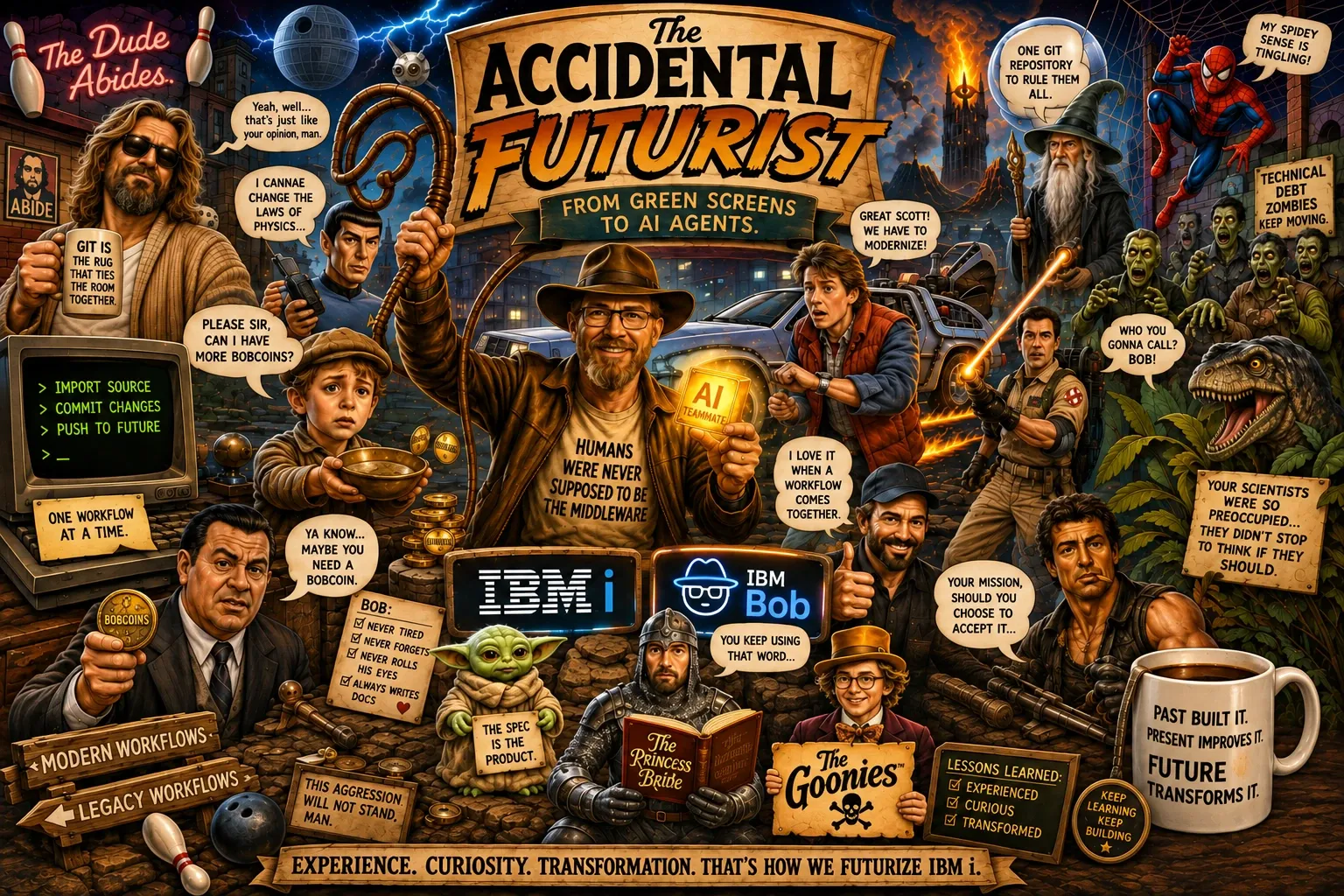
If you’ve read some of my recent articles, you’ve probably noticed I have a rather unhealthy fondness for classic movies from the 1980s and 1990s.
What can I say?
I’m a child of the Information Age!
I grew up during an era when computers were beginning to change the world, imagination seemed to have no limits, and Hollywood had us believing that a bunch of kids could find pirate treasure, a teenager could help build a time machine out of a DeLorean, and a couple of geeks could create their dream woman with a computer.
And somewhere along the way, Willy Wonka planted a particularly dangerous idea in my impressionable young mind:
“We are the music makers, and we are the dreamers of dreams.”
Well, THAT explains a lot.
Because apparently, I never quite outgrew the notion that with enough imagination, curiosity, ingenuity, and perhaps a little questionable judgment, almost anything is possible!
Fast-forward a few decades, and here I am, an IBM i veteran playing with artificial intelligence, building AI agents, experimenting with modern engineering tools, and occasionally wondering whether I’ve stumbled into the next great technological revolution—or the plot of another 1980s science-fiction movie.
GREAT SCOTT! I THINK WE’RE ONTO SOMETHING!
The more I explore AI-assisted engineering, the more I’m reminded of that same sense of wonder and possibility.
Except this time, we’re not building time machines, hunting pirate treasure, or creating Kelly LeBrock with a computer.
We’re uncovering decades of buried business knowledge, connecting technologies that once seemed worlds apart, and rediscovering engineering possibilities that became impractical as our applications and organizations grew.
And here’s the REALLY exciting part…
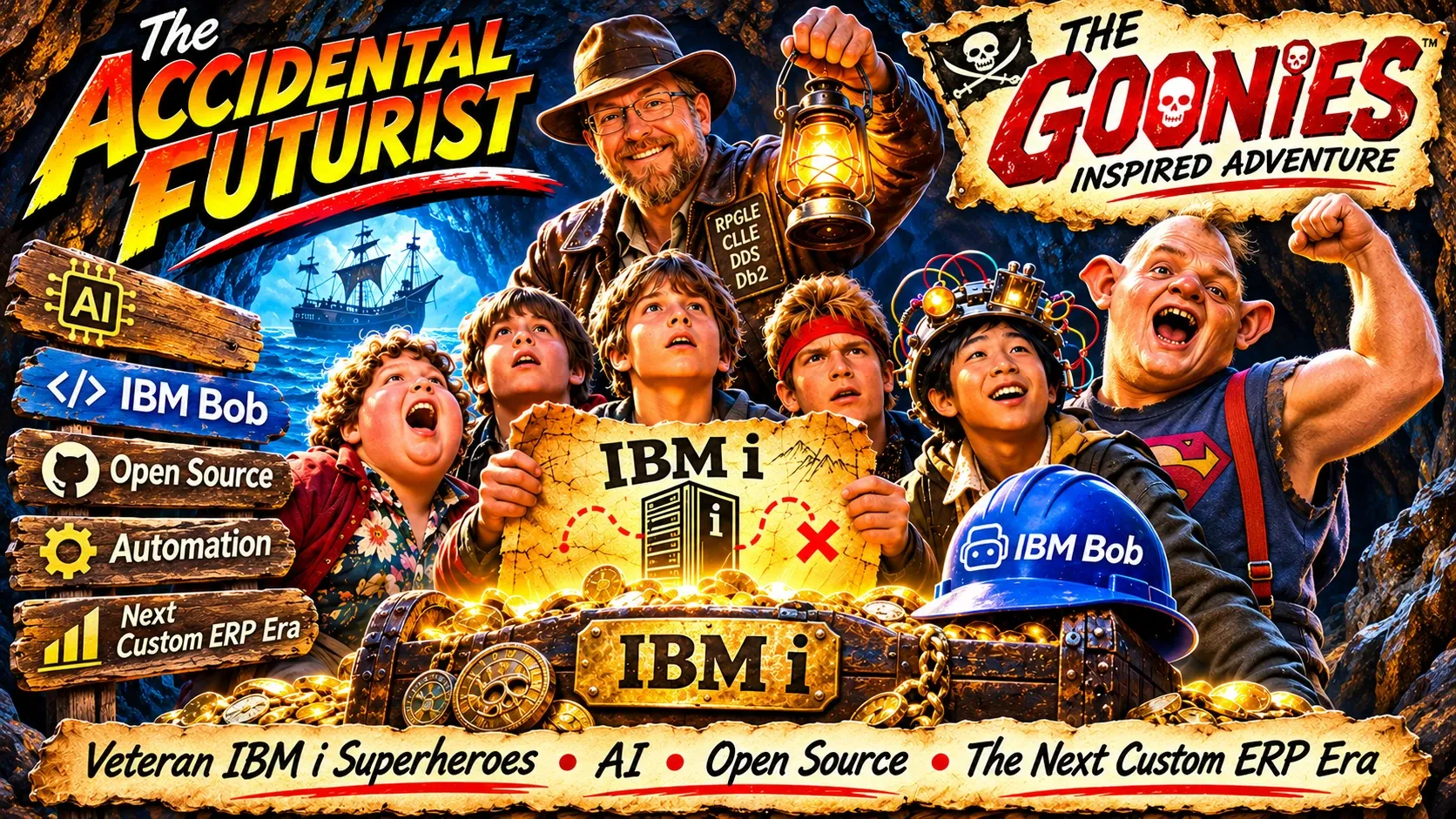
We already have an extraordinary collection of IBM i superheroes who know exactly where much of that treasure is buried!
The very engineers who helped build the first Custom ERP Era may be uniquely positioned to help engineer the next one.
And something tells me this adventure is going to be one heck of a ride! 🏴☠️
Developers.
Architects.
Engineers.
Educators.
Mentors.
Open-source contributors.
People who have spent entire careers solving complicated business problems and building systems that organizations still depend on.
Many of these veterans are now experimenting with AI, sharing knowledge, creating tools, mentoring younger engineers, and challenging long-held assumptions about what’s possible.
And some are beginning to catch on to the crazy ideas I’ve been writing about.
Fellow veteran IBM i superheroes… YOU KNOW WHO YOU ARE!
I believe the next great adventure isn’t about replacing the people who built the first generation of custom ERP systems.
It’s about empowering them to help engineer the next one.
GOONIES NEVER SAY DIE!
And apparently, neither do IBM i engineers.
So… What’s This Blog Actually About?
I’m glad you asked.
The Accidental Futurist is where I’ll share my experiences, experiments, observations, occasional failures, and sometimes completely ridiculous ideas about the future of software engineering on IBM i.
Some articles will be technical.
Others will focus on strategy, engineering practices, leadership, and the challenges facing IBM i organizations.
And occasionally, I’ll wander into territory that makes even me wonder what the heck I’m thinking.
But here’s the thing. This adventure is about MUCH more than writing a blog!
It’s also about offering professional IBM i consulting services, hands-on training, and mentoring to help organizations turn these ideas into practical, measurable results.
I’m bringing over three decades of IBM midrange application development experience together with modern DevOps practices, IBM Bob, and AI-assisted engineering to help organizations modernize their development capabilities, empower their engineering teams, preserve decades of business knowledge, and prepare for the next era of custom software development.
And I’m not interested in simply telling organizations what’s possible. I want to roll up my sleeves, work alongside their teams, and help them actually make it happen!
I’ve written the code. Maintained the applications. Wrestled with the technical debt. Worked alongside business users. Survived the production emergencies. And occasionally wondered who the heck designed something so complicated… only to discover it was ME, twenty years earlier!
I speak IBM i. I speak RPG, CL, DDS, Db2, and modern DevOps. And perhaps most importantly, I understand the business realities behind the technology.
My goal isn’t to show up with a fancy PowerPoint presentation, sprinkle a little AI fairy dust over your applications, and disappear into the sunset.
It’s to work alongside your engineers, share what I’ve learned, learn from their experiences, and help your organization turn emerging technologies into practical engineering capabilities.
Whether that’s adopting IBM Bob, introducing modern development practices, building reusable AI skills, extracting decades of business knowledge, or mentoring the next generation of IBM i engineers, I want to help organizations move beyond simply talking about modernization.
I want to help them BUILD what’s next.
Because after all these years, one thing hasn’t changed:
The best way to learn, innovate, and accomplish something extraordinary is to roll up your sleeves and actually DO IT!
And if we can have a few laughs along the way?
Even better.
Here’s what you can expect.
IBM Bob Adventures
Hands-on experiments with IBM Bob, reusable skills, rules, lifecycle hooks, MCP integrations, AI-assisted development, and engineering automation.
Not simply what the technology promises.
What can we actually build with it?
AI-Assisted Software Engineering
Exploring how AI can help with business rule extraction, legacy code analysis, documentation, testing, application development, and the engineering workflows surrounding all of them.
Because generating code is interesting.
Engineering better software delivery processes is considerably more exciting.
Beyond Modernization: The Next Custom ERP Era
My ongoing exploration of a fairly ambitious idea:
What if organizations could once again build highly tailored business applications economically, combining decades of institutional knowledge with AI and modern software engineering?
Not every organization needs to build its own ERP system.
But I believe the economics and possibilities of custom software development are beginning to change.
And that deserves serious exploration.
Open Source, Git, and Modern DevOps
Practical tools, workflows, sample applications, and reusable resources that help IBM i teams adopt modern engineering practices.
I’ll also share some of my own experiments and GitHub projects.
Because I firmly believe that we learn by doing—and we get better by sharing what we learn.
The People Behind the Technology
This might be the most important topic of all.
How do we preserve institutional knowledge?
How do we help experienced engineers share what they’ve learned?
How do we bring the next generation of developers into the IBM i ecosystem?
And how do we create environments where veteran engineers and younger developers can learn from each other?
I’ve been incredibly fortunate to work with exceptional leaders, mentors, and engineers throughout my career.
Many challenged me to think differently, explore new technologies, and push beyond my comfort zone.
I wouldn’t be where I am today without them.
The best way I know to honor those people is to pay it forward.
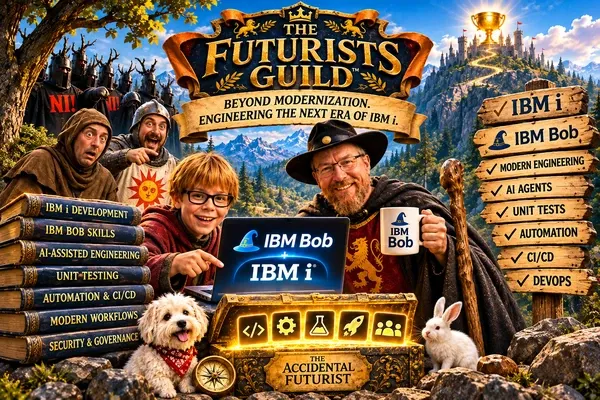
Introducing The Futurists Guild
As these ideas have evolved, so has another ambition.
The Futurists Guild.
Veteran Engineers. Artificial Intelligence. Extraordinary Possibilities.
The concept is simple.
Bring together like-minded IBM i professionals who believe that our collective experience, combined with emerging technologies, can help organizations move beyond traditional modernization.
A community of engineers, innovators, educators, and problem-solvers willing to experiment, collaborate, build, and share.
Not another organization devoted exclusively to discussing what the future might look like.
A group of people interested in actually building it.
It’s an evolving idea, and one I hope to explore much further.
Our guiding principle?
Beyond Modernization. Engineering the Next Era of IBM i.
The Greatest Adventure May Still Be Ahead of Us
When I began my career in 1988, I couldn’t possibly have imagined the technology we’d be working with today.
I certainly didn’t imagine having conversations with AI agents capable of helping analyze applications that were written before some of today’s developers were even born.
Yet here we are.
And after all these years, I find myself just as excited about engineering possibilities as I was when I first started.
Perhaps even more excited.
Because this time, we’re not starting from scratch.
We have decades of applications, business knowledge, engineering experience, and hard-earned lessons to build upon.
We have an extraordinary IBM i community.
And we’re gaining access to technologies that may fundamentally change how we design, build, maintain, and deliver software.
The greatest legacy of an experienced engineer isn’t the code they leave behind. It’s the next generation of engineers they mentor and empower to become part of the next Custom ERP Era that AI will surely bring us.
That’s what this adventure is about.
Preserving what matters.
Challenging what doesn’t.
Learning new things.
Sharing what we discover.
And occasionally having a little fun along the way.
So whether you’re a veteran IBM i superhero, a developer just beginning your journey, an engineering leader exploring AI adoption, or simply someone curious about what comes next…
WELCOME TO THE ADVENTURE!
Grab your treasure map.
Bring your curiosity.
And don’t forget your sense of humor.
Because if my instincts are even remotely correct…
WE’RE JUST GETTING STARTED!
🏴☠️ GOONIES NEVER SAY DIE!
Cheers, and thanks for reading.
— The Accidental Futurist
From Green Screens to AI Agents.
Beyond Modernization. Engineering the Next Era of Custom Software Development on IBM i.