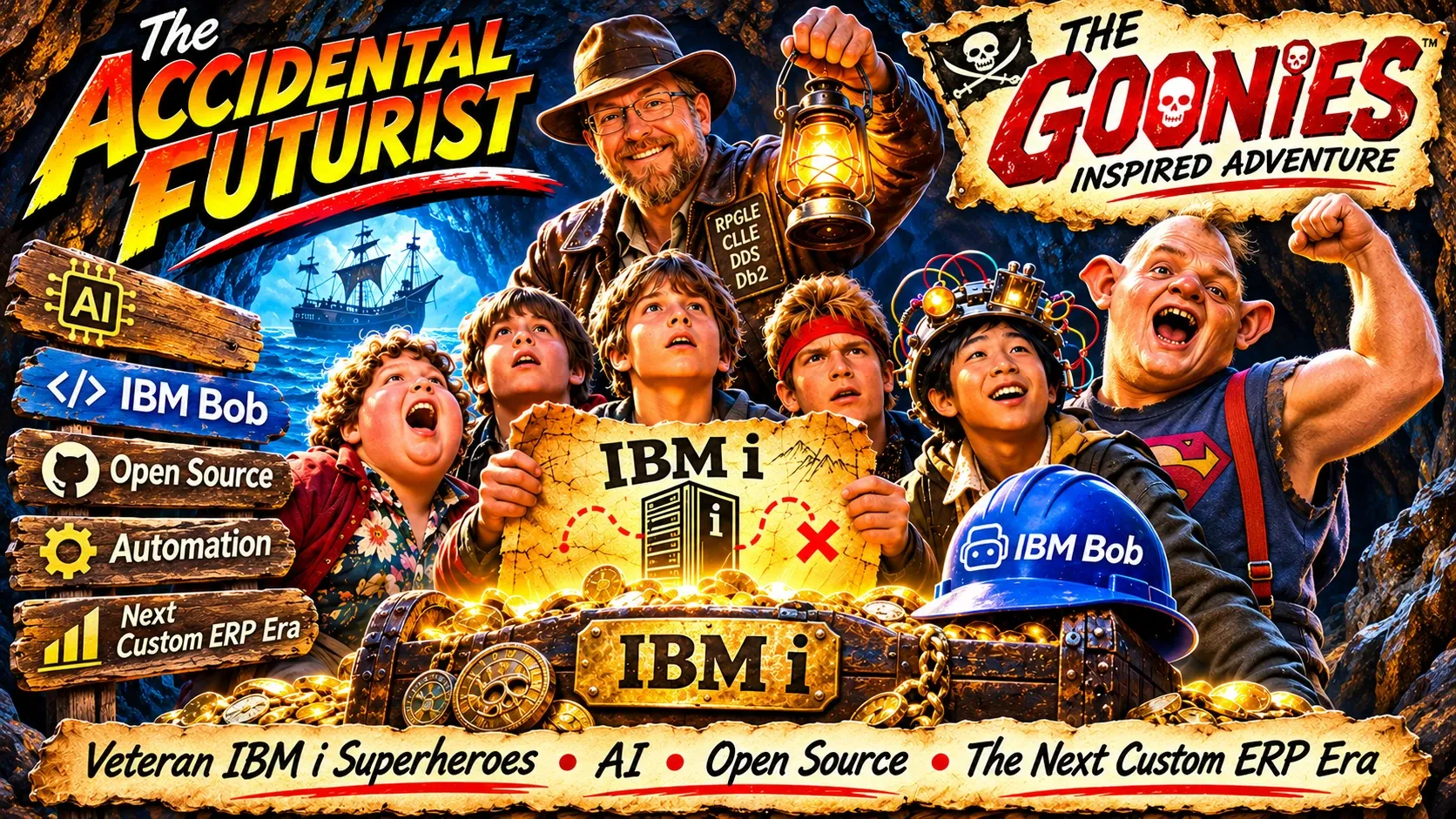
The Accidental Futurist: IBM i Superheroes, IBM Bob, AI, Open Source, and the Quest for the Next Custom ERP Era
Hey, You Guys! The IBM i Goonies Are Still Here!
Remember The Goonies (1985)?
A ragtag group of unlikely heroes discover an old treasure map and set off on an adventure filled with hidden passages, elaborate booby traps, mysterious obstacles, and the Fratellis—a family whose approach to project management makes some of our legacy modernization initiatives look positively organized.
For a kid like me, this movie had EVERYTHING!
That close-knit group of friends we all remember growing up with.
Back when our parents had absolutely no idea where we were, what we were doing, or how many questionable decisions we’d made that afternoon.
The only rule? Be home before the streetlights came on!
Every kid had their own personality, their own quirks, and their own talents. Nobody expected anyone to be anything other than who they were.
Throw in adventure, pirates, buried treasure, secret tunnels, a misunderstood giant with a heart of gold, and a bunch of kids trying to save their parents’ homes…
WHAT’S NOT TO LOVE?!
And somehow, that wonderfully mismatched group of friends accomplished something extraordinary simply by working together, improvising, and refusing to give up.
Now, tell me that doesn’t sound a little like the IBM i engineering community!
After all, we’ve certainly had our share of adventures.
Ancient artifacts. Hidden dependencies. Mysterious interfaces. Integration requirements that apparently violate several known laws of physics.
And somewhere, deep inside the cavern, there’s a vendor contract requiring three signatures, an annual renewal, and a sacrifice to the licensing gods.
I’m beginning to think One-Eyed Willy’s treasure was easier to find than a fully integrated IBM i development toolchain!
But just like the Goonies, our community has something that makes it extraordinarily resilient.
We have people who refuse to give up—veteran engineers armed with decades of practical, hands-on experience, and now empowered by IBM Bob and AI to turn that hard-earned knowledge into extraordinary new possibilities!
Veteran engineers, architects, developers, educators, and problem-solvers who have spent decades adapting, innovating, and keeping mission-critical business applications running.
Good grief! We’ve survived more technology revolutions than the Fratellis have survived jailbreaks!
And we’re STILL HERE!
But this time, something is different.
AI and open source are changing what’s possible—and the veteran IBM i superheroes are already leading the adventure.
GOONIES NEVER SAY DIE!
IBM i ORGANIZATIONS, ARE YOU PAYING ATTENTION?
Because something rather extraordinary is happening in our little corner of the technology universe.
And if you’ve spent a few decades navigating the mysterious caverns of IBM i modernization, you know the adventure all too well.
One vendor has an amazing feature. Another has an incredible development tool. A third offers the automation you’ve been dreaming about.
Unfortunately, they’re all buried in different treasure chests, guarded by different licensing agreements, and require a small army of consultants just to figure out how to make them work together.
By the time you’ve connected everything, untangled the dependencies, negotiated the licensing, and convinced the various products to play nicely together, you’ve created something considerably more complicated—and expensive—than the problem you originally set out to solve.
Sometimes going without the shiny new feature seems like the better adventure!
But something exceptional is happening.
The veteran IBM i superheroes aren’t waiting around for someone to hand them another expensive treasure map.
They’re using AI, open source technologies, custom engineering automation, and perhaps their greatest asset of all—decades of accumulated knowledge about how to efficiently solve real business challenges through software engineering.
And here’s something I think we’ve almost forgotten.
My fellow IBM i Veterans, remember back in the day when we actually wrote our own development tools?
We didn’t always have a commercial product for every problem. We built our own utilities, development frameworks, code generators, testing tools, and automation because we understood what needed to be accomplished—and we knew how to engineer a solution.
Heck, many of those homegrown innovations helped lay the groundwork for the ERP systems, software development lifecycle (SDLC) tools, and development tools we rely on today!
We weren’t just writing applications. We were inventing the tools that helped us build them!
Somewhere along the way, we became increasingly dependent on buying, licensing, and integrating solutions that other people engineered.
And don’t get me wrong—many of those products are exceptional.
But what if AI and open source are giving us the opportunity to rediscover something we were once extraordinarily good at?
Building exactly what we need, when we need it, using the business knowledge and engineering experience we’ve spent decades accumulating.
Only this time, instead of spending weeks or months developing those tools, we have AI helping accelerate the process.
The veteran IBM i superheroes aren’t learning how to become innovators.
We’ve been innovators all along!
And now they’ve got an entirely new collection of gadgets that would make Data from The Goonies green with envy.
Think about that. Obstacles we’ve spent decades navigating are suddenly becoming opportunities to engineer something better.
And this time, we might actually reach One-Eyed Willy’s treasure without having to purchase six different software licenses along the way!
One-Eyed Willy’s Treasure Map: We’ve Been Searching in the Wrong Places!
For decades, IBM i organizations have been searching for the perfect modernization treasure chest.
The development environment that does everything.
The integration platform that connects everything.
The automation solution that eliminates repetitive work.
The documentation tool that understands decades of business logic.
The testing framework that makes application changes safer.
And, of course, the magical, all-in-one, AI-powered miracle product that promises to solve every problem, integrate with everything, make your morning coffee, eliminate technical debt, and slash your IT budget by 50%—all before lunch. Some assembly required. Batteries not included. Actual results may vary. Consultants sold separately. 😂
Spoiler alert: We’re still looking for that last one.
The problem isn’t that these commercial products lack value.
Many are exceptional, and the IBM i ecosystem has benefited enormously from the companies and engineers who developed them.
The problem is that the capabilities organizations need are frequently scattered across multiple products, platforms, licensing models, and integration frameworks.
It’s like finding One-Eyed Willy’s treasure map…
Only to discover that one vendor owns the compass, another licenses the flashlight, a third sells the shovel, and somebody else wants a recurring subscription for access to the cave.
And don’t even get me started on the licensing fees!
But what if we’ve been approaching this adventure from the wrong direction?
What if the treasure isn’t a single product?
What if the real treasure is our ability to engineer exactly what we need?
WAIT! Somebody stop the Truffle Shuffle! 😂
Are you suggesting we could actually BUILD solutions tailored to our unique business requirements, rather than continually adapting our processes to fit the capabilities and limitations of off-the-shelf software?
Um…..Yes…
AI, open source, and modern engineering automation are making that possibility increasingly practical.
Not by eliminating the need for commercial software.
But by giving organizations the freedom to choose where commercial solutions make sense—and where their own engineers can create something better suited to their needs.
Now THAT is a treasure map worth following!
Data’s Wonderful Gadgets: Open Source Changes the Adventure!
Remember Data?
The kid had a gadget for practically everything.
Some worked brilliantly.
Others looked like they were assembled from spare parts, questionable assumptions, and an impressive amount of enthusiasm.
As an engineer, I can relate.
Welcome to the wonderful world of open source!
Except our modern collection of gadgets includes:
-
Git and modern source control.
-
Python, Node.js, JavaScript, and modern programming frameworks.
-
REST APIs and integration technologies.
-
Automated testing and continuous integration.
-
Containers and deployment automation.
-
AI frameworks, agents, and Model Context Protocol (MCP) integrations.
-
Thousands of reusable libraries, utilities, and community-driven tools.
And the best part?
We don’t have to invent every gadget ourselves!
Open source gives IBM i organizations access to innovation happening across the broader technology community.
It expands our options, encourages interoperability, reduces unnecessary vendor dependency, and makes experimentation considerably more accessible.
Instead of asking whether a particular vendor supports a capability, we can increasingly ask a much more interesting question:
Can we engineer that capability ourselves—or integrate an existing open source solution?
And when you combine those possibilities with the business knowledge of an experienced IBM i engineer?
Oh, the places we can go!
Of course, open source isn’t magic. It still requires security, maintenance, testing, governance, and responsible engineering.
But here’s the difference.
We now have a much larger toolbox, and we’re no longer limited to whichever gadgets happen to be available in a single vendor’s catalog.
Data would be ecstatic.
He’d probably build an AI-powered grappling hook before lunch.
And by dinner, he’d have it connected to Db2 for i.
Whether anyone actually needed an AI-powered grappling hook is another question entirely.
But that’s never stopped an enthusiastic engineer before!
Sloth Loves Chunk! And AI Loves Veteran Engineers!
Now here’s where this adventure gets REALLY interesting.
For years, we’ve heard the same concerns about the IBM i community.
Our engineers are getting older.
Institutional knowledge is disappearing.
Legacy applications are becoming harder to maintain.
Finding experienced developers is increasingly difficult.
And somehow, the proposed solution often involves replacing decades of business knowledge with an expensive new platform.
Wait a minute.
Have we considered what happens when we give those same veteran engineers AI?
I’m talking about people who understand the business.
Not just the code.
The engineer who knows why the inventory allocation process works a particular way.
The developer who understands the relationship between purchasing, merchandising, distribution, and financial systems.
The architect who remembers why a seemingly ridiculous business rule was implemented thirty years ago.
The people who know where the real treasure is buried.
Now give them AI tools capable of assisting with code analysis, documentation, prototyping, testing, integration, and automation.
Then add open source technologies and the ability to create reusable engineering workflows.
BOOM!
Suddenly, we’re not talking about engineers struggling to keep pace with technology.
We’re talking about experienced engineers using technology to multiply the value of everything they’ve learned.
Think about Sloth and Chunk.
Two unlikely heroes who discovered that working together made them capable of something neither could accomplish alone.
That’s how I see the relationship between veteran IBM i engineers and AI.
AI brings speed, computational assistance, and an extraordinary ability to help explore technical possibilities.
The veteran brings judgment, business context, architectural understanding, and decades of experience.
And just like Sloth, when that combination finally breaks through the wall…
HEY, YOU GUYS!!!
Of course, AI occasionally produces something that looks convincing but is completely wrong.
Which is why I prefer having a veteran engineer standing nearby.
Someone who can look at the generated code and say:
“That’s impressive.”
“That’s clever.”
“That’s also going to destroy our inventory balances.”
And THAT, my friends, is why experience still matters!
The Fratellis of Modernization: Who Says We Have to Keep Running Through the Same Traps?
Every great adventure needs obstacles.
And the IBM i community has certainly encountered its share.
Expensive integration projects.
Disconnected development tools.
Knowledge silos.
Complex licensing arrangements.
Vendor lock-in.
Manual processes that should have been automated years ago.
Here’s a thought: Maybe our biggest obstacle isn’t the technology we’re trying to modernize.
Maybe it’s the decades-old thinking we’re still using to manage it.
At least Mikey and the gang had One-Eyed Willy’s treasure map to guide them through the booby-trapped caverns. We’ve been navigating ours with outdated project plans, endless status meetings, and the occasional prayer!
We’ve been running through these caverns for decades!
But something fascinating is happening.
AI-assisted development is helping engineers build and connect capabilities faster.
Open source is expanding the technologies available to IBM i organizations.
Custom engineering automation is allowing teams to create reusable workflows tailored to their own environments.
And experienced IBM i engineers are beginning to combine these technologies in ways that previously required significantly more time, money, and specialized resources.
But here’s where this adventure gets REALLY interesting!
What if we stopped focusing exclusively on modernizing applications and started reimagining the entire engineering and delivery process?
Because, let’s face it, some of our biggest obstacles aren’t buried in decades-old RPG code.
They’re buried in the processes we’ve built around it!
The First Booby Trap: The Project Management Maze
You know the drill.
Business requirements go to an analyst.
The analyst creates documentation.
The documentation goes to a technical lead.
The technical lead creates specifications.
The specifications go to developers.
Developers write code.
Code moves to testing.
Testing discovers something was misunderstood three handoffs ago.
And suddenly we’re back at the entrance to One-Eyed Willy’s cavern, wondering who moved the treasure map.
Congratulations! We’ve successfully turned a perfectly reasonable business requirement into a six-month archaeological expedition!
Traditional, linear, single-dimensional project management approaches can create enormous amounts of administrative overhead, disconnected handoffs, and unnecessary waiting.
But what if AI agents and custom automation could help coordinate those activities, maintain project context, track dependencies, and automatically communicate progress?
What if project status reflected what’s actually happening in engineering workflows rather than requiring another meeting, spreadsheet, or status report?
Imagine spending more time engineering solutions and less time explaining why we’re not finished engineering solutions!
The Second Booby Trap: The Never-Ending Engineering Assembly Line
Consider how much time our teams spend on activities surrounding the actual development work.
Code reviews.
Unit testing.
QA testing.
Regression testing.
Documentation.
Change-impact analysis.
Release preparation.
Project status reporting.
Delivery coordination.
Now imagine connecting those activities through an integrated, AI-assisted engineering workflow.
A developer completes a change.
Automated tools analyze the code, identify potential issues, and execute unit tests.
AI assists with documentation and prepares change summaries.
QA workflows generate or execute relevant test scenarios and report the results.
Project tracking updates automatically as verified milestones are completed.
And the appropriate engineers remain responsible for reviewing, approving, and promoting changes.
We’re not eliminating engineering discipline. We’re automating the repetitive work required to enforce it!
Instead of purchasing another half-dozen disconnected tools and hoping they cooperate, experienced engineers can increasingly build the automation that connects the entire delivery cycle.
Heck, even Chunk would drop his Baby Ruth for THAT! And we all know how much Chunk loves his Baby Ruth! 😂
The Third Booby Trap: The Great Requirements Translation Disaster
And then there’s one of my personal favorites.
The incredible journey of a business requirement through an IT organization.
A business user explains what they need.
Someone translates that into business requirements.
Someone else translates those into functional requirements.
Another person produces technical specifications.
Eventually, a developer receives the assignment.
And somewhere along the way, the original business problem has been transformed into something that vaguely resembles what the business actually requested.
It’s like trying to get directions from Mouth—by the time the message reaches its destination, nobody knows what was actually said, and somehow everyone’s plumbing is involved!
But what if AI could help preserve the original business intent throughout the entire engineering process?
Imagine a connected workflow where business requirements, functional specifications, technical designs, development tasks, test cases, and final deliverables remain linked.
Changes to requirements can be analyzed for their impact on downstream work.
Acceptance criteria can be traced to automated tests.
Documentation can evolve alongside the application.
And business stakeholders can validate working prototypes early, before misunderstandings become expensive surprises.
The goal isn’t simply to automate the handoffs. It’s to eliminate unnecessary handoffs and preserve the knowledge that gets lost between them!
Now THAT could fundamentally change how we engineer custom business applications.
The Treasure: Engineering the Entire Journey
Consider what this could mean for a traditional IBM i organization.
Instead of purchasing another standalone utility, perhaps we build a focused automation tool.
Instead of manually documenting hundreds of programs, perhaps we create an AI-assisted documentation workflow.
Instead of spending weeks investigating unfamiliar application dependencies, perhaps we develop tools that accelerate analysis and produce useful visualizations.
Instead of managing development, testing, documentation, and project reporting as disconnected activities, perhaps we engineer a coordinated workflow that connects them.
And instead of waiting for someone else to deliver the perfect solution…
Perhaps we build it ourselves!
Not every problem should be solved with custom code.
Sometimes the commercial product is absolutely the right answer.
But AI, open source, and the decades of expertise our veteran IBM i engineers have accumulated are giving us more options than ever before.
And having more options changes the conversation.
Because the real opportunity isn’t simply to make our developers write code faster.
It’s to remove the organizational friction that prevents great engineers from delivering great business solutions!
The Fratellis are still out there.
The booby traps haven’t magically disappeared.
But for the first time, we have an extraordinary new collection of tools to help us navigate around them—or dismantle them altogether.
And this time, my fellow Goonies, we’re not just escaping the cavern.
WE’RE REENGINEERING THE ENTIRE TREASURE HUNT!
The Pirate Ship Is Real! The Next Custom ERP Era Is Coming!
Now we arrive at the part of the adventure that really gets my engineering imagination running.
Remember when the Goonies finally discovered One-Eyed Willy’s pirate ship?
After all the tunnels, traps, setbacks, and seemingly impossible obstacles…
There it was.
The treasure they’d been searching for.
Well, I believe the IBM i community may be approaching its own version of that moment.
The next era of Custom ERP applications.
For decades, organizations have faced difficult choices between maintaining highly customized business applications and adopting packaged ERP solutions.
Custom applications can provide extraordinary business alignment, but historically they’ve also required significant engineering effort.
Packaged ERP solutions can provide standardization and broad functionality, but often require compromises in how an organization operates.
Now imagine what becomes possible when AI, open source, and custom engineering automation begin changing the cost and speed of developing business software.
Imagine an experienced IBM i engineer sitting directly beside a business stakeholder.
Together, they describe a business problem.
AI helps analyze the requirements, explore existing application logic, and accelerate the development of a working prototype.
And here’s something particularly exciting: AI is a powerful business rule extraction engine for our legacy applications!
Decades of business knowledge buried deep within RPG, COBOL, CL, and database logic can now be analyzed, documented, and transformed into reusable knowledge—helping us rediscover why our applications work the way they do, not simply how they work.
This excites me to no end! I’m talking Sloth-and-Chunk-discovering-a-lifetime-supply-of-Baby-Ruth-bars levels of excitement! 😂
Let’s continue….
Reusable engineering tools generate documentation, assist with testing, and automate repetitive development activities.
Open source technologies provide integration capabilities, user interfaces, and frameworks that connect the new functionality with existing IBM i applications.
And the engineer remains responsible for ensuring that the solution is correct, secure, maintainable, and aligned with the business.
Think about what that could mean for smaller engineering teams!
The tight feedback loop between business knowledge and software development—the very thing that made the first Custom ERP Era so powerful—could become practical again on an entirely new scale.
Not because AI replaces experienced engineers.
Because AI helps experienced engineers accomplish things that were previously impractical at scale.
In many ways, it’s bringing us full circle—back to the principles that made the first generation of custom ERP applications so successful: close collaboration with business users, rapid development, immediate feedback, and engineers who deeply understood the business problems they were solving.
But as our organizations grew, development teams expanded, processes became more complex, and the original engineers moved on or retired, much of that agility and institutional knowledge was lost.
AI gives us an extraordinary opportunity to reclaim what we lost—not by abandoning the benefits of scale, but by restoring the speed, accuracy, collaboration, and business understanding that made those early custom ERP applications so effective in the first place.
That’s the opportunity I find so exciting.
We’re not simply talking about making old applications look newer.
We’re talking about reimagining how custom business applications are engineered.
Beyond Modernization. Engineering the Next Era of IBM i.
And unlike One-Eyed Willy’s treasure…
We don’t have to steal it.
We can build it!
The REAL Superheroes of This Adventure Deserve a Standing Ovation!
Before we reach the end of today’s adventure, there’s something I want to say.
And I mean every word of it.
To the veteran IBM i engineers who continue to innovate, experiment, mentor, teach, share, and contribute to our community:
THANK YOU!
You know who you are.
The developers creating open source tools and publishing their work on GitHub.
The engineers experimenting with AI agents, MCP servers, and custom engineering automation.
The architects connecting IBM i to modern technologies.
The educators producing tutorials, demonstrations, and training materials.
The community contributors answering questions, sharing ideas, and helping others overcome technical challenges.
The people who have spent decades mastering their craft—and still approach a new technology with the enthusiasm of a kid discovering a secret treasure map.
YOU are the superheroes of this adventure!
And what I admire most is that so many of these people are doing it because they genuinely love engineering.
They love solving problems.
They love sharing knowledge.
They love seeing a good idea succeed-regardless of who came up with it.
And they love proving that IBM i has an extraordinary future.
I’ve been fortunate throughout my career to learn from some exceptional engineers, mentors, and leaders.
Many of the skills and opportunities I’ve enjoyed throughout my career came from people who were willing to share what they knew.
And now, as AI and open source open up entirely new possibilities, I see another opportunity for our generation of engineers.
To help the next generation accomplish things we could only dream about.
That’s the treasure worth protecting.
That’s the treasure worth sharing.
And that’s the treasure that can keep growing long after we’ve hung up our keyboards.
Goonies Never Say Die. Neither Does IBM i!
So, IBM i organizations…
ARE YOU PAYING ATTENTION YET?
Because while some people are still debating the future of IBM i, a remarkable group of veteran engineers is already busy helping create it.
They’re experimenting with AI.
They’re embracing open source.
They’re building custom engineering automation.
They’re connecting technologies that previously seemed impossible—or prohibitively expensive—to integrate.
They’re sharing their discoveries.
And they’re helping dismantle barriers that have challenged our community for decades.
Think about that.
The same engineers who helped build and maintain the first generation of custom business applications are now helping pioneer the next one.
And this time, they have access to tools and technologies that fundamentally change what’s possible.
The treasure isn’t buried somewhere on One-Eyed Willy’s pirate ship.
It’s in our collective experience.
Our business knowledge.
Our engineering creativity.
Our willingness to experiment.
And our extraordinary IBM i community.
The next Custom ERP Era isn’t waiting for somebody to hand us a treasure map.
We’re drawing the map ourselves!
So to all my fellow veteran IBM i superheroes…
Keep experimenting.
Keep building.
Keep sharing.
Keep mentoring.
And for goodness’ sake, keep having fun!
Because the adventure is just getting started.
And if somebody tells you that IBM i is a dying platform, just smile, point toward the treasure, and give them your best Sloth impression.
HEY, YOU GUYS!!!
GOONIES NEVER SAY DIE!
AND NEITHER DO IBM i ENGINEERS!
— The Accidental Futurist
Beyond Modernization. Engineering the Next Era of IBM i.